
How I helped one E-commerce brand generate $10,000 with
1 post,
an Extra $32,000 in 4 weeks from just
4 posts.
I help $20k+/mo e-commerce brands add 20% more revenue in 30 days by writing your emails and stories. Zero extra ad spend. Done for you.
Your product page is losing sales,
Here's the Fix,
Let me show you...
I'm Francois Pistorius
Creative strategist and direct-response copywriter
Curiosity → Story → Sales: a simple system for e-commerce ROI
Who this is for
Ecommerce brands
Offer owners
Founders and business owners selling online
Case study:

What one email and one story page did for a DTC e-commerce brand, and what happened when the system scaled to the full list.
$10,000 — Result from the initial test (1 email + 1 story page)
$32,000 — Extra revenue generated over the following 4 weeks by re-engaging the list and building story experiences around the products
320% — The extra $32k is more than 3x the result of the initial $10k test.
$18,000 — Generated from a single CSS content post
What happened
Step 1 — The test
One email. One story page, linked directly to the product page. No discount, no gimmick. Just curiosity in the subject line and a real story on the landing page. Result: $10,000 in sales.
Step 2 — The scale
The same system was rolled out across the full email list. Story experiences built around the products, not just product shots, but the story of how each product fit into a customer's life. Over the next 3 weeks, this generated an additional $32,000 in sales, a list that had gone quiet, taken from 0 sales to $32,000 in 4 weeks total.
Step 3 — The nurture
Relationship-building emails, written using the same CSS structure, kept the list warm between launches. From a single CSS content post, this nurture sequence generated up to $18,000 results with only one CSS post.
Why it worked
Curiosity got the list opening emails again, instead of ignoring them.
Story gave buyers a reason to care, not just a reason to scroll.
Sales gave every story one clear next step, it's a simple sales system that works.
Every dollar could be traced back to the exact email, story, or post that drove it.
CSS Performance Offer
No fixed fee, performance only.
Help six-figure + e-commerce brands generate more revenue from the customers, subscribers and warm audiences they already have.
Close the trust gap for e-commerce brands by turning your active email list and ready-to-buy audience into revenue through high-converting product stories and experiences.
Do all the heavy lifting and implementation completely upfront at zero initial cost to you. In return, I only get paid based on a percentage of the performance upside and measurable revenue we generate together.
The CSS Revenue Activation System
Curiosity creates attention and reactivates interest.
Story makes the product relevant, credible and emotionally meaningful.
Sales connects the story to a clear product decision and action.
Precise Performance Model
The baseline period
2 campaigns to test over 2 weeks.
The campaign period
2 weeks.
What counts as incremental revenue
Revenue from this campaign model generated.
The attribution window
30 days.
Which platform is the source of truth
Email, page and website with backend data.
Whether discounts are included
Depends on the e-commerce brand offer
How refunds and cancellations are handled
On brands side
Your percentage of the upside
20% upside.
Payment timing
2 days after each send and again after 30 days.
Access and implementation responsibilities
I handle the entire campaign, research and setup with your team.
The test duration
2 weeks to 6 weeks
What happens if the campaign produces no upside.
No fees to pay out.
Offer Structure
You don't pay an upfront fee.
Focus on existing demand rather than asking for more ad spend.
The work is tied to a specific revenue opportunity.
The brand sees the plan before committing.
I carry execution risk.
Both parties agree on measurement before launch.
Why this matters
A good product is not enough. Buyers need a reason to act now.
Most product pages show features. They do not tell a story. Most emails sell. They do not pull the reader in.
Without a system, every sale is luck. With CSS, every sale has a path.
Your product page isn't losing traffic. It's losing sales.
Here's what's actually happening in your business right now:
A buyer lands on your product page. Sees a photo. Sees a price. No story. No reason to buy today. They leave.
Your email list sits there, quiet. Thousands of people who already said yes once. You send a discount. They ignore it. No curiosity, no reason to open.
Your competitor's product isn't better than yours. Their story is. And their story is what's winning the sale.
Every day this stays broken, you lose three things at once: new sales walking away, old customers going quiet, and free traffic going to someone else instead of you.
You spend more on ads and quietly ignore the people already on your list.
That's not a traffic problem or a product problem. That's a story problem.
Here's the fix.
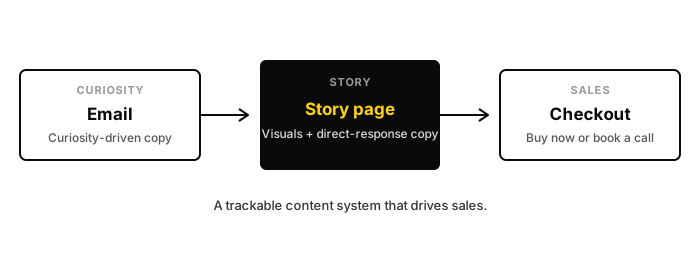
The Curiosity → Story → Sales System turns browsers into buyers — in three steps.
It's the same system that took one email and one story page from $0 to $10,000 in sales, then added another $32,000 by reconnecting a quiet list.
If your product page isn't converting, or your list has gone cold, this is for you.
A simple, three-step content system to help ecommerce brands and online sellers see ROI.
Testimonials
The first email generated and extra $10k.
Then we added an extra $32k in only four weeks.
The best part, the content keeps generating sales living on our e-commerce store.
Pedro Ramos
LosAmigos Cigars
2022 to current
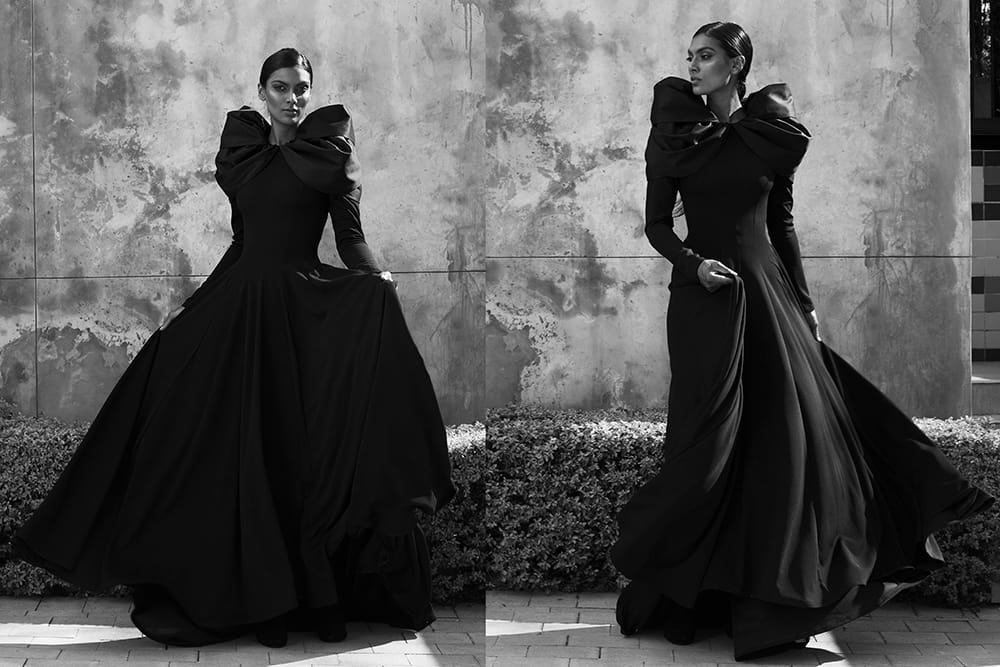
His work is of the highest quality, and he ALWAYS over delivers.
Francois will always be our number one choice for interior and food photography!
Danette Maree
Creative Director
North Star Micro Hotel | Milner Fashion House | Mister C
2026
Since ERRE started working with Francois in 2018 - Erre's Instagram following went from 2000 followers to 29k followers to date.
To conclude:
Our Instagram grew exponentially
Our online sales grew and keeps on growing.
And every shoot and collaboration is something we look forward to."
Carina - Co- Founder, ERRE Fashion
2026


The CSS Framework
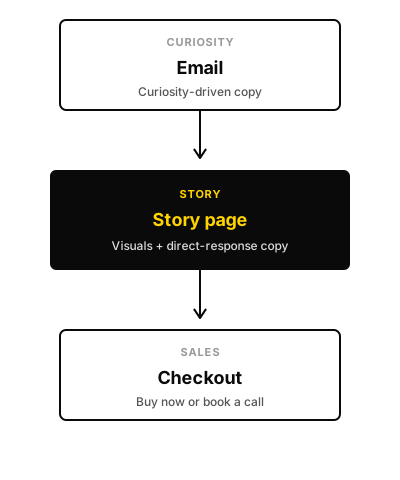
A trackable, three-step content system that turns browsers into buyers, and turns a quiet email list back into a revenue channel.
Most brands only do one of the three. CSS does all three,, and every sale can be traced.
1. I write the story your ecommerce product page is missing.
Visual and direct-response copy that shows exactly how the product solves a real problem or improves the customer's life, not just what it does.
2. I write emails that make people want to click.
Curiosity-driven copy that pulls the reader straight through to the story page, not another promotional email they scroll past.
3. I close the loop.
The story page links directly to a clear call to action, buy now or book a call, so every e-commerce sale can be traced back to the content that drove it.
This works for e-commerce checkouts and book-a-call funnels alike, anywhere a story needs to end in a decision.
Why it works
Built by a creative who shoots the photos and writes the copy, not one or the other.
Not "more content." A system where every piece of content has a job to do.
Trackable by design, you see exactly which email, story, or post drove each sale.
Works on new buyers (acquisition) and existing buyers (re-engagement) at the same time.
8 reasons your business needs this
1. Stops losing sales because your brand doesn't share stories. A page with a story gets read, not scrolled past.
2. Makes your emails worth opening, curiosity beats "New Arrivals" every time.
3.Turns browsers into buyers, every step moves the reader closer to a decision.
4. Keeps current customers buying, nurture is the system that brings buyers back.
5. Traces every sale to its source, no guessing what worked.
6. Builds trust before the ask, story earns belief, belief makes the sale easier.
7. Replaces guesswork with a system, every piece of content has a job to do.
8. Protects your business from being forgettable , buyers remember brands that earned their attention.
If you are building to scale let's do an audit. Book a call below.
But there is more...
Creative Strategy, Full Stack
CSS is a gap I spotted, because retention drives LTV. But CSS is one piece of a bigger system.
I started with CSS because it is the fastest way I helped a client get results. It is a small, contained system with a clear before and after. It is easy to test and easy to trust.
But the same direct response skill behind CSS runs the whole account.
As a full stack marketer I look at your funnel, retention and ads.
The ads that brings your new buyers in.
The funnel that turns clicks into sales
And the retention system that drives LTV.
One discipline, applied at every stage.
Here is how I approach that full system, starting with the ads.
How I Approach Creative Strategy. 10 Bullet Points
How I Approach Creative Strategy. 10 Bullet Points
1. I look at the data first. to see what is broke. I never write a new ad without the data.
2. I pull the customer data from real sources. Reviews. Comments. Support messages. Their own words, not my guesses.
3. I create ideas and angles before I write any copy. Who the buyer is. What problem needs solving. What result they expect expect.
4. I build every ad in parts. The opening line, the story, the proof, the offer, the call to act. Each part can change on its own.
5. I test one thing at a time. One change per test, so the result means something.
6. I decide based on the data. I scale winners. I cut what is weak.
7. I follow the same order every time. Customer and ad data, then angle, then story, then opening line, then proof. There is no room to skip a step.
8. I keep a record of every test. That record, not any single ad, is the real asset.
9. If an ad earns clicks but no sales, the problem sits past the click. I flag it and look for bottlenecks in the entire funnel.
10. I run this process every week, on a fixed rhythm. Diagnose, write, produce, test, review, repeat.
Are you a DTC brand building to scale?
Your ads are not converting. Your list has gone quiet.
Both have a real, fixable cause and solution.
I write direct response ads and copy that scale, using data, not guesses.
Let's start with a diagnostic call.
Here is what you get.
1. I review your last ten ads and flag what is weak: the idea, the opening line, or the offer.
2. I check your email list for the clearest sign of drop-off in your retention flow.
3. I pull customer truths from your reviews or comments, in the customer's own words.
4. I name three distinct angles you are not using yet.
5. I flag one funnel risk, in plain terms, based on what the data shows.
6. I hand you a four-week test roadmap, built around what I find.
One document. Yours to keep, whether we work together or not.
If you are building to scale let's do a diagnostic. Book a call below.
If you are building to scale let's do an audit. Book a call below.
FAQ
Buyers do not act on features. They act on stories. If your product page and emails do not tell a clear story, buyers scroll past. They buy from someone else who made it easy to say yes.
Because it follows how people actually decide. Curiosity gets them to look. Story gets them to care. Sales gets them to act. Skip a step, and you lose the sale. CSS builds all three, in order, every time.
You keep losing sales you never see. Buyers visit. They leave. No story, no reason to stay. Your current customers stop hearing from you in a way that keeps them buying. No nurture, no repeat sales. You lose twice — once on new buyers, once on existing ones.
More content without a system is noise. CSS is not about posting more. It is about posting with a purpose. Content built to move a buyer from curious to convinced to sold.
Yes. The same system that turns browsers into buyers keeps buyers coming back. Curiosity keeps them opening your emails. Story keeps them trusting your brand. Sales keeps the cart moving.
Curiosity = engage.
Story = resonate
Sales = results
I combine creative strategy with the CSS framework to help you scale.
Research
Strategy, Ideate,Angles & Hooks
Choose & create stories
Create product experiences
Write curiosity emails
Easy sales flow
CSS stands for Curiosity, Story, Sales — a three-step content system that moves an e-commerce buyer from attention to purchase. Each step has a single job: Curiosity gets the email opened, Story gives the buyer a reason to care about the product, and Sales connects the story to one clear action.
The CSS Performance Offer has no upfront fee. Francois carries the execution risk and is paid a percentage of the measurable revenue the campaign generates — 20% of the incremental upside with payment due two days after each send and again after 30 days. If the campaign produces no upside, no fee is owed. Terms & conditions apply.
CSS: Curiosity, Story, Sales. The retention system.
Creative Strategist. Direct response copywriter. I write ads that scale, fix the funnel, and bring old customers back.
Francois Pistorius
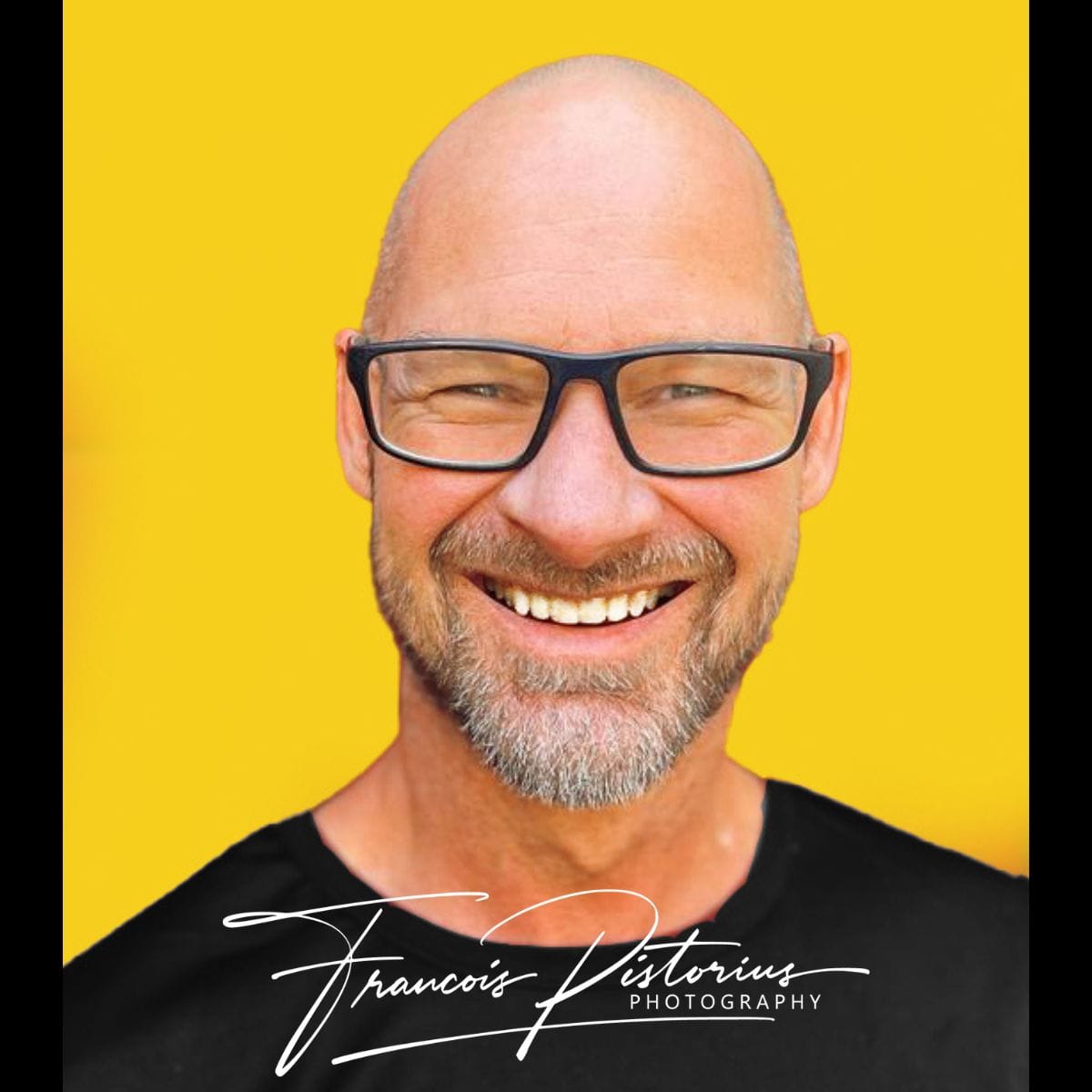
I help you convert and scale.
Stories • Scale • Systems
Business Growth & Creative Strategist | Built to convert: from a single photo to a full revenue system.
I studied RMBC direct-response training under Stefan Georgi. Stefan Georgi is a highly prominent direct-response copywriter and entrepreneur who has generated over $1 billion in sales through his sales letters and co-created the widely adopted RMBC (Research, Mechanism, Brief, Copy) copywriting framework. Paired with direct response marketing I spent almost 30 years behind a camera and on creative teams nationally and internationally. Nothing I create gets built unless it's built to convert.
Most people split that into two jobs. A creative makes it look good. A direct response marketer makes it work. I don't split it, because the split is the problem: a beautiful asset with no system behind it is a moment, not a result, and a system with no story behind it has nothing worth converting in the first place.
So I build both, as one discipline, at whatever altitude a business needs it: a photo or video engineered to stop the scroll and move someone to act, a landing page or funnel built to carry that attention somewhere, or the growth architecture behind a business preparing to scale past founder-dependency altogether.
Where are you stuck?
Book an introduction call here.